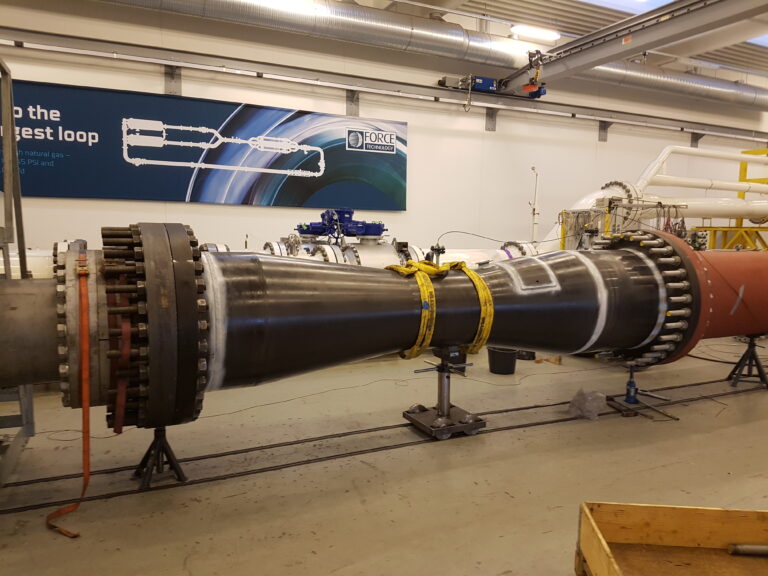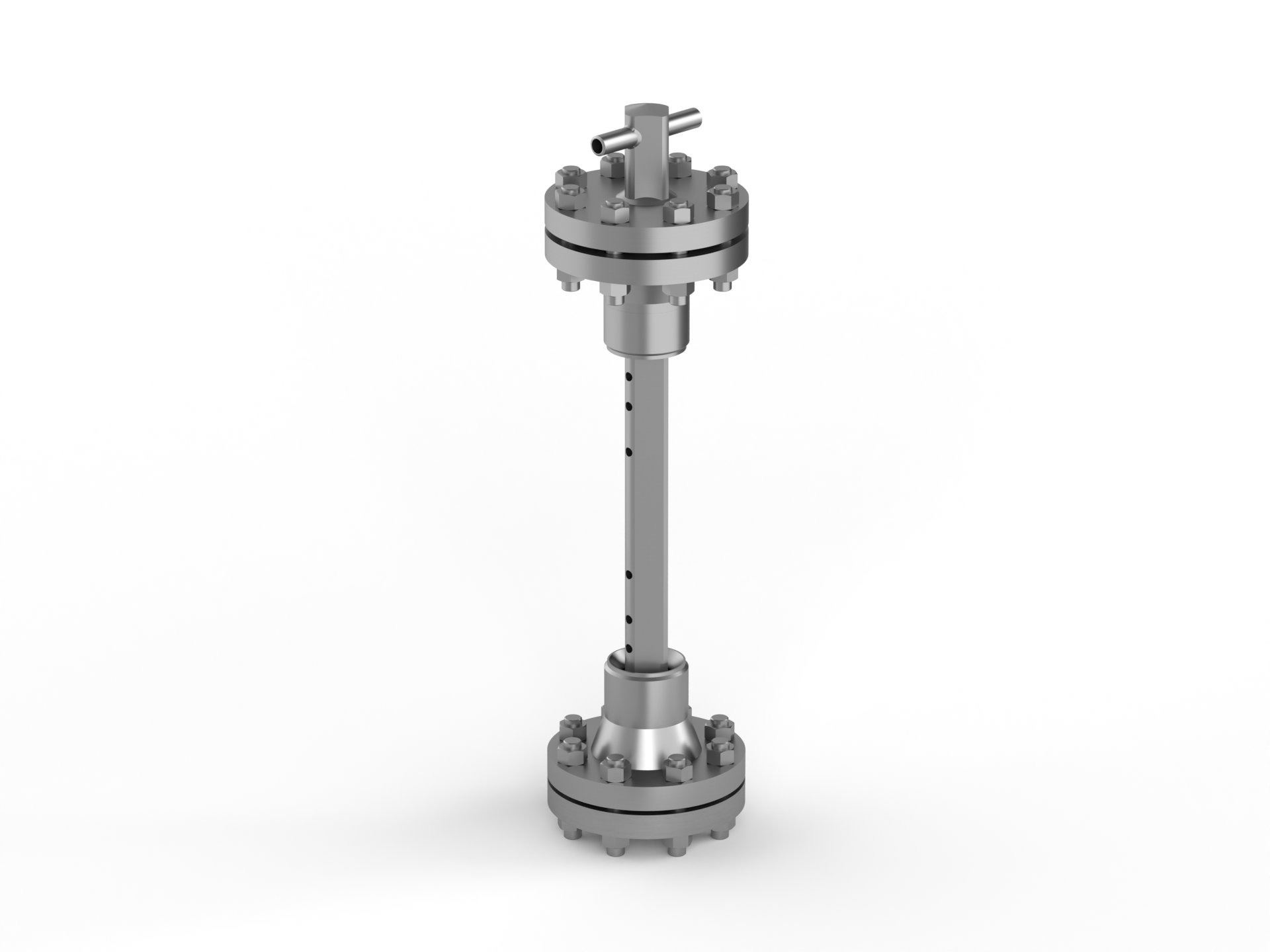
The PITOBAR Averaging Pitot Tube is used to measure the flow of liquid and gasses in horizontal or vertical pipe lines. Its working principle is derived from the classic or single point pitot tube. However, as opposed to the single point pitot tube, the PITOBAR Averaging Pitot Tube has a number of holes depending on pipe size pointing towards the upstream side. One port pointing downstream measures the static pressure. The main advantages of this flow element are its low installation costs and low pressure loss compared to other flow elements, especially in larger pipe sizes.
|
|
|
|
Design and calculation standards
|
VDE/VDI 2640, ASME, DIN, EN 13480
|
|
Types
|
PC450 & PC455
|
|
Pipe sizes
|
DN 500 - DN 6000: 20" - 240"
|
|
Probe sizes
|
45 x 45 mm
|
|
Pressure rating
|
up to PN 100 (600lbs)
|
|
Temperature range
|
-100°C - +300 °C
|
|
Material PITOBAR
|
Stainless steel AISI 316, other stainless grades on request
|
|
Material mounting part
|
Carbon steel, stainless steel AISI 316, other on request
|
|
Process connection
|
Flange according to pressure rating
|
|
Flange standards
|
DIN, ANSI, others on request
|
|
Mounting
|
Welding to the pipe
|
|
Instrument connection
|
½" BSP or NPT
|
|
|
|
|
Accuracy
|
± 1% accuracy of actual flow
|
|
Repeatability
|
± 0,1%
|
|
Reynolds no.
|
Minimum 100.000 at full flow
|
|
Rangeability
|
10:1
|
|
Max. fluid velocity
|
Liquids 5 m/s, gasses 80 m/s
|
|
|
|
|
Shut-off valves: needle or ball
|
Certain installation requirements for straight pipe lines must be fulfilled in order to achieve the most accurate flow measurement. See table below.
Upstream (x D) |
Downstream (x D) |
|
|---|---|---|
|
Single 90° bend
|
9
|
3
|
|
Two or more 90° bends in the same plane
|
14
|
3
|
|
Two or more 90° bends in in different planes
|
24
|
4
|
The PITOBAR Averaging Pitot Tube is constructed and designed with a diamond shaped strut with several ports spaced centrally within concentric rings of equal area pointing towards the upstream side. This is done in order to get the best averaging measurement of the dynamic pressure, resulting in a more
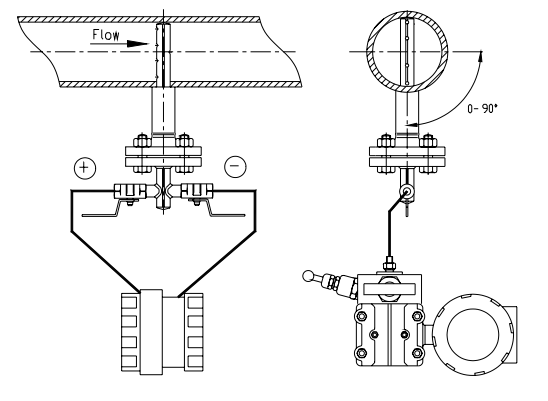
accurate flow reading. The pitot tube creates a differential pressure signal which is proportional to the flow rate: Differential Pressure = ( Pstatic + Pdynamic) – Pstatic.
For optimal installation, the pitot tube should be placed in a straight cylindrical pipe with consistent cross-sectional area and free from obstructions. The inner pipe diameter must not deviate by more than 0.3% for accurate differential pressure calculations. To ensure accurate measurements, it is recommended to use full bore valves upstream of the primary element. The inner pipe wall roughness should meet specific limits depending on the material used. For steam flow, a horizontal mounting with a 5-degree slope is advised to facilitate condensate flow. Purge connections are available for fluids with impurities, and regular maintenance is suggested to maintain accurate readings. For proper instrument connection, the differential pressure transmitter should be positioned below the pitot tube for liquid and steam flow, and above it for gas flow, with impulse lines sloped to allow air escape.
Download the installation guide above for more detailed information.
| Cookie | Duration | Description |
|---|---|---|
| cookielawinfo-checkbox-advertisement | 1 year | Set by the GDPR Cookie Consent plugin, this cookie is used to record the user consent for the cookies in the "Advertisement" category . |
| cookielawinfo-checkbox-analytics | 11 months | This cookie is set by GDPR Cookie Consent plugin. The cookie is used to store the user consent for the cookies in the category "Analytics". |
| cookielawinfo-checkbox-functional | 11 months | The cookie is set by GDPR cookie consent to record the user consent for the cookies in the category "Functional". |
| cookielawinfo-checkbox-necessary | 11 months | This cookie is set by GDPR Cookie Consent plugin. The cookies is used to store the user consent for the cookies in the category "Necessary". |
| cookielawinfo-checkbox-others | 11 months | This cookie is set by GDPR Cookie Consent plugin. The cookie is used to store the user consent for the cookies in the category "Other. |
| cookielawinfo-checkbox-performance | 11 months | This cookie is set by GDPR Cookie Consent plugin. The cookie is used to store the user consent for the cookies in the category "Performance". |
| elementor | never | This cookie is used by the website's WordPress theme. It allows the website owner to implement or change the website's content in real-time. |
| viewed_cookie_policy | 11 months | The cookie is set by the GDPR Cookie Consent plugin and is used to store whether or not user has consented to the use of cookies. It does not store any personal data. |
| Cookie | Duration | Description |
|---|---|---|
| _ga | 2 years | The _ga cookie, installed by Google Analytics, calculates visitor, session and campaign data and also keeps track of site usage for the site's analytics report. The cookie stores information anonymously and assigns a randomly generated number to recognize unique visitors. |
| _ga_* | 1 year 1 month 4 days | Google Analytics sets this cookie to store and count page views. |
| _gat_UA-* | 1 minute | Google Analytics sets this cookie for user behaviour tracking. |
| _gat_UA-151202324-1 | 1 minute | A variation of the _gat cookie set by Google Analytics and Google Tag Manager to allow website owners to track visitor behaviour and measure site performance. The pattern element in the name contains the unique identity number of the account or website it relates to. |
| _gid | 1 day | Installed by Google Analytics, _gid cookie stores information on how visitors use a website, while also creating an analytics report of the website's performance. Some of the data that are collected include the number of visitors, their source, and the pages they visit anonymously. |
| CONSENT | 2 years | YouTube sets this cookie via embedded YouTube videos and registers anonymous statistical data. |
| VISITOR_INFO1_LIVE | 5 months 27 days | YouTube sets this cookie to measure bandwidth, determining whether the user gets the new or old player interface. |
| YSC | session | Youtube sets this cookie to track the views of embedded videos on Youtube pages. |
| yt-remote-connected-devices | never | YouTube sets this cookie to store the user's video preferences using embedded YouTube videos. |
| yt-remote-device-id | never | YouTube sets this cookie to store the user's video preferences using embedded YouTube videos. |
| yt.innertube::nextId | never | YouTube sets this cookie to register a unique ID to store data on what videos from YouTube the user has seen. |
| yt.innertube::requests | never | YouTube sets this cookie to register a unique ID to store data on what videos from YouTube the user has seen. |